
Sondir / CPT
Cone penetration testing measuring tip resistance and sleeve friction to characterize soil stratigraphy in situ.
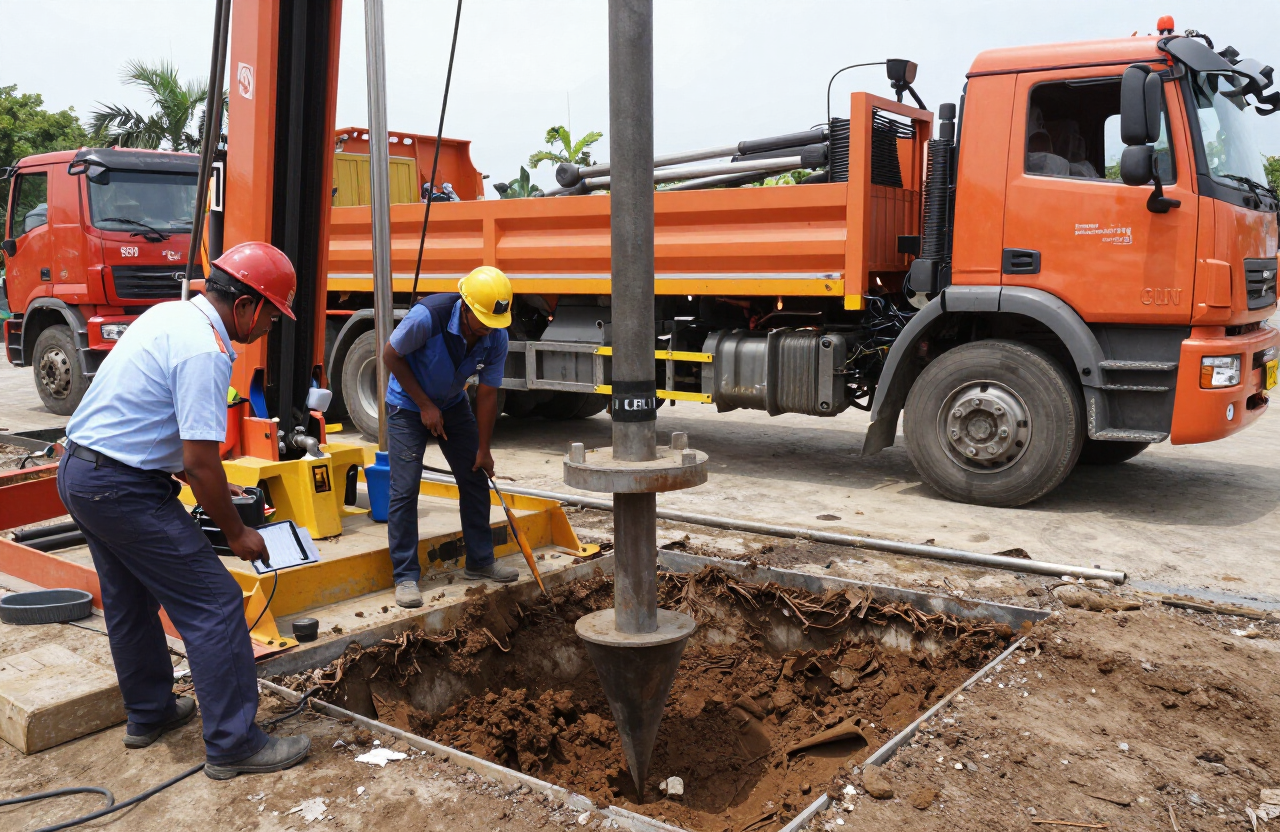
Sondir (CPT) pushes an instrumented cone into the ground at a constant rate, continuously recording cone tip resistance, sleeve friction and pore pressure to derive soil type, strength and stratigraphy without drilling.
Overview
CPT provides a continuous in-situ soil profile from measured tip resistance and sleeve friction.
Scope of Services
- CPT point layout and planning
- Cone penetration at 2 cm/s
- Continuous qc, fs and u recording
- Soil behaviour type interpretation
- Engineering parameter correlation
- CPT log and report delivery
Key Benefits
- Continuous soil profile
- No borehole required
- Fast and repeatable
- Pore pressure (CPTu) option
Applications
- Foundation design
- Soil stratigraphy
- Liquefaction assessment
- Embankment and road
Industries
- Construction
- Infrastructure
- Property
- Industrial
- Government
- Oil & Gas
Methodology
Cone pushed at 2 cm/s, continuous recording of qc, fs and u, soil behaviour type interpretation, correlation to engineering parameters.
Equipment / Technology
CPT rig, instrumented cone (CPT/CPTu), data acquisition system.
Deliverables
Technical Specifications
Rate: 2 cm/s | Channels: qc, fs, u (CPTu) | Depth: up to 30 m typical
Workflow / Process
1. Point layout
2. Rig setup & pushing
3. Continuous recording
4. Interpretation
5. Report delivery
FAQ
Q: CPT or boring?
A: CPT is faster and continuous; boring recovers samples. We often combine both.
Q: How deep?
A: Typically up to 30 m depending on soil resistance.
Request a CPT investigation
Tell us the site and target depth for a CPT program proposal.
Start a Project