
SPT – Standard Penetration Test
In-situ SPT during boring to measure soil resistance and derive bearing capacity and liquefaction potential.
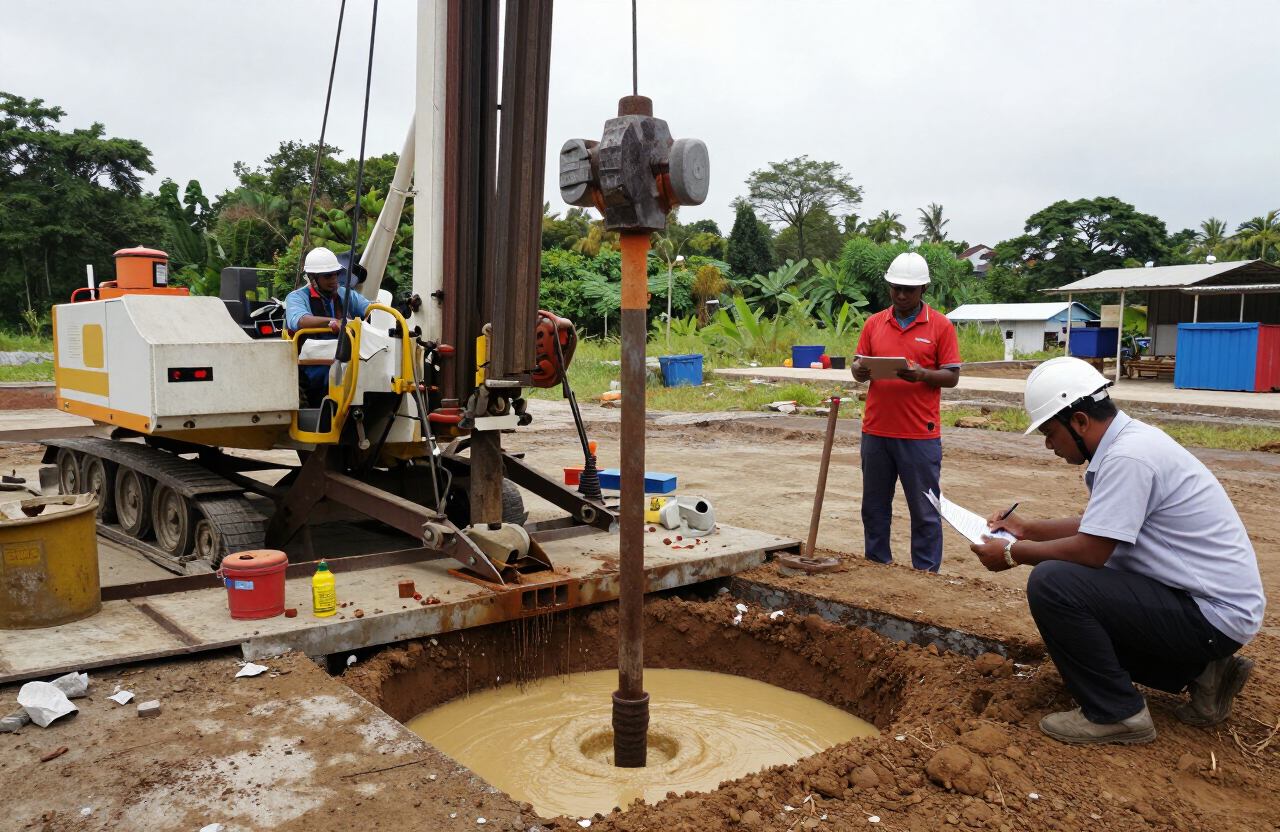
The Standard Penetration Test drives a split-spoon sampler with a drop hammer and counts blows per 30 cm (N-value), an index of soil density and strength used for bearing capacity and liquefaction analysis.
Overview
SPT measures blow counts (N-value) in boreholes to index soil density and strength.
Scope of Services
- SPT during boring at design intervals
- Split-spoon driving and blow counting
- N-value computation per ASTM D1586
- Bearing capacity derivation
- Liquefaction screening
- SPT data and report delivery
Key Benefits
- Standardized N-value
- Bearing capacity input
- Liquefaction screening
- In-situ during boring
Applications
- Foundation bearing
- Liquefaction analysis
- Soil density
- Settlement estimate
Industries
- Construction
- Infrastructure
- Property
- Industrial
- Government
Methodology
Split-spoon driven by 63.5 kg hammer dropping 76 cm; count blows per 15/15/15 cm; N = middle 30 cm sum, per ASTM D1586.
Equipment / Technology
Split-spoon sampler, 63.5 kg drive hammer, drilling rig.
Deliverables
Technical Specifications
Standard: ASTM D1586 | Hammer: 63.5 kg @ 76 cm drop | N: blows/30 cm
Workflow / Process
1. Borehole to test depth
2. Drive split-spoon
3. Count blows per 30 cm
4. Compute N-value
5. Interpret & report
FAQ
Q: What is a good N-value?
A: It depends on soil and design — higher N generally means denser, stronger soil.
Q: Is SPT the same as CPT?
A: No — SPT is blow-count based in boreholes; CPT is continuous cone resistance.
Request SPT testing
Tell us the borehole program and design parameters for an SPT proposal.
Start a Project